

Explore the District Through Oral History
Why oral history?
DC is home to over 700,000 people. Oral history creates an inclusive record of residents’ experiences in their own words. Audio interviews retain the tone, emotion, and essence of a person, providing a unique lens into their life.
Listen by Ward
Discover more about the individuals highlighted at each site by listening to their oral history clips. Each playlist is organized by ward.
Experience each ward’s story in its intended sequence using the video players below. To browse individual videos or skip ahead, click a ward title to view its full playlist on YouTube

Established in the 1970’s, the DC Latino Festival (Fiesta DC) began as a neighborhood gathering in Mount Pleasant and Adams Morgan. By 1989, it had grown into a regional celebration on the National Mall. Arturo Griffiths describes how the festival evolved into a powerful display of cultural identity and civic presence.

Defying restrictions of legal segregation, the U Street corridor served as a self-sustaining cultural hub. Growing up in 1950s Shaw and U Street, Betty May Brooks-Cole remembers a neighborhood defined by its vibrant social fabric. Holidays like Easter were significant public displays of community pride and elegance.

Surrounded by DC’s legacy of national protest and community advocacy, Washingtonians learn from a young age how to advocate for their communities. Flor Rivas reflects on how her mother’s early encouragement to join immigrant rights marches paved the way for her to become a lifelong advocate for civil rights.

Demonstrating the tight-knit sense of community across Ward 8’s neighborhoods, Ernestine Byrd Hamilton’s neighbor Mr. Clark helped her learn to parallel park little by little, day by day, until she was able to do it on her own.
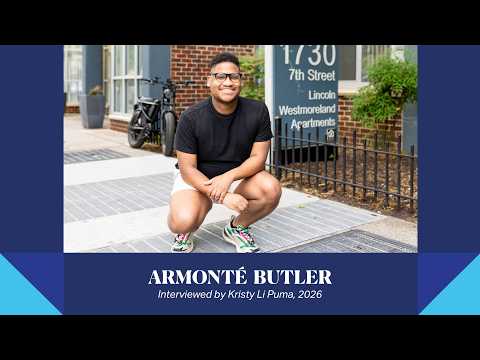
In the District, even a historic blizzard can become a foundation for community tradition. Since the record-breaking “Snowmageddon” of 2010, the annual Dupont Circle snowball fight transforms this city park into a space of collective joy. Armonté Butler reflects on how his father’s dedication to sharing local experiences like this has given him lasting memories and shaped his connection to the city as an adult.
Opened in 1974, the Dupont Circle bookstore Lambda Rising became a national landmark for queer culture. Jane Troxell recalls its publication, the Lambda Book Report, which provided critical reviews that helped mainstream publishers and readers recognize gay and lesbian authors.

In the late 1970s and 1980s, parts of Northwest DC became the heart of a homegrown punk and hardcore scene. This community transformed local businesses and sidewalks into spaces for creative exchange, spreading a “Do-It-Yourself” (DIY) spirit across neighborhoods. Despite decades of neighborhood change, internationally acclaimed punk rocker Henry Rollins recalls a familiarity with these paths.

Lyfoung moved to the District in 2015 and, as a social justice oriented attorney, quickly gravitated towards helping Washingtonians keep their homes and maintain the character of their commercial corridors. As a bike commuter, Lyfoung gets a sense of pride from riding through the city, past buildings where she’s helped residents.
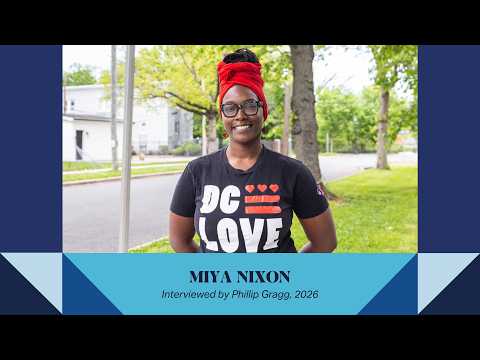
Eager to teach her son more about the city they both call home, Nixon takes her son on frequent bus and train rides from their home in Southeast Washington, to neighborhoods across the District.

While the District is often defined by its monuments and restricted spaces, local youth still find ways to reclaim the city as their own. Rock reflects on her time as a teenager in the 1970’s when she scaled the scaffolding of the Washington National Cathedral to reach its rooftops.

Williams describes how the DC Black Pride Parade, started in 1991 as one of the first Black gay pride festivals in the United States, evolved to support many other linked causes.

Wright describes the spontaneity of the District’s parks, where for years, the only requirement for gathering was showing up. Before the introduction of formal permits and increased fees in 2014 by the National Park Service, residents would gather for cookouts and recreation in these collective backyards.

The 1973 Home Rule Act restored local government to the District, allowing residents to elect their own mayor and council for the first time in over a century. However, the federal government maintains final say over the city’s laws and budget. Banks notes that without a vote in Congress, the fight for full representation and the rights of citizenship is not yet over.

Wright and his wife, Desiree, are proud lifelong Washingtonians. As newlyweds, they briefly considered raising their family outside the city but ultimately chose to stay rooted in their hometown.

Nelson recalls Ms. Lewis, his favorite teacher at Lasalle Elementary School, where he was a student in the 1960’s. He remembers how students often expressed their fondness for their teachers by giving gifts and helping with small tasks around the classroom.
Interested in learning more about oral history?
Check out the DC Oral History Collaborative for more resources.
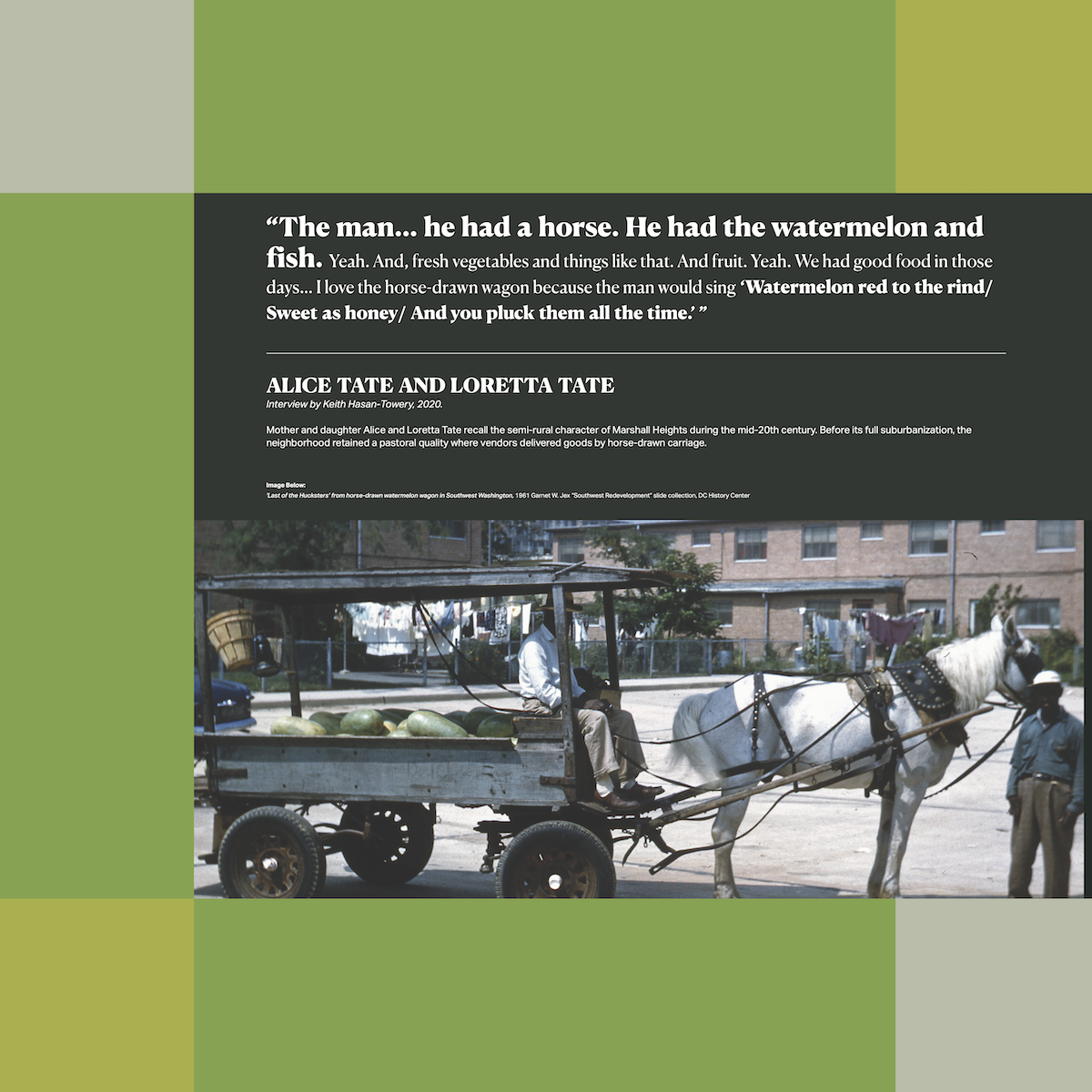
Shia recalls critical neighborhood food sources at the local co-op run by the Adams Morgan Organization (AMO). Communal spaces like co-ops and farmers markets provided residents with access to local and affordable groceries.